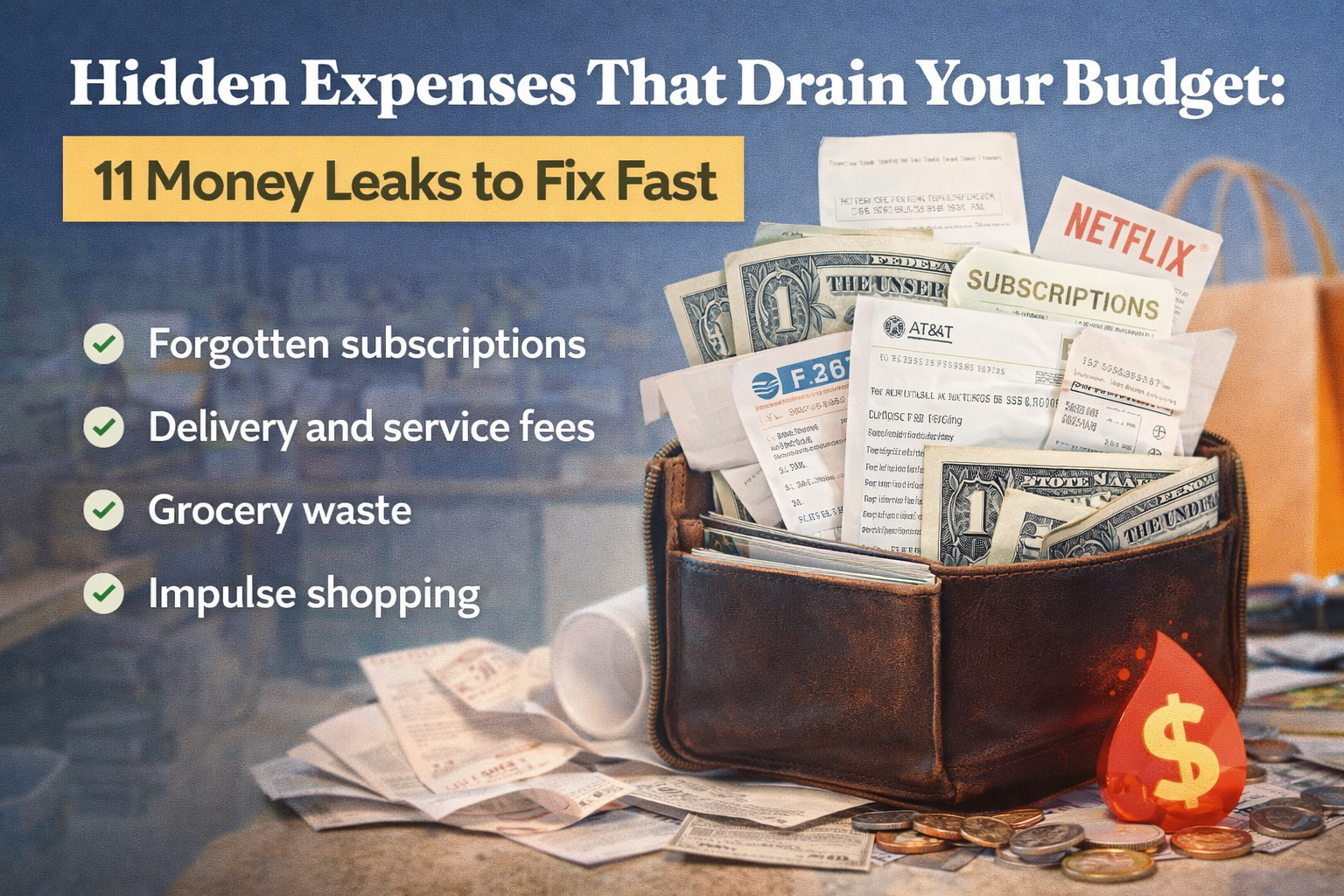
Hidden Expenses That Drain Your Budget: 11 Money Leaks to Fix Fast
Table of Contents
If you want to understand the hidden expenses that drain your budget, the first thing to know is that most money problems do not come from one huge mistake. They usually come from small spending leaks that repeat every week until a big part of your income quietly disappears.
That is why so many people look at their bank balance and ask, “Where did all my money go?” The answer is often not one dramatic purchase. It is a group of unnoticed habits, recurring charges, convenience spending, and small decisions that feel harmless in the moment but expensive over time.
The good news is that once you identify the hidden expenses that drain your budget, it becomes much easier to cut waste, spend with more intention, and feel more in control of your money.
If you want a faster first step, start with the Free Leak AuLeak Audit – Free PDFdit to quickly identify the spending categories draining your monthly budget.
What Are Hidden Expenses?
Hidden expenses that drain your budget are costs that often go unnoticed because they feel small, automatic, or normal.
They are not always secret expenses. They are usually visible, but ignored.
Examples include:
- subscriptions you forgot about
- delivery fees
- impulse purchases
- grocery waste
- convenience spending
- auto-renewals
- bank charges
- daily food habits
- emotional spending
These money leaks become dangerous because they repeat often and rarely get reviewed in a structured way.
If you want a practical method to find them, read How to Find Leak Audit – Free PDFMoney Leaks before your next spending review.
Why Hidden Expenses Are So Dangerous
The reason hidden expenses that drain your budget are so frustrating is simple: they do not feel serious in the moment.
A small app charge does not feel dramatic.
A delivery fee does not feel like a problem.
A coffee, snack, or quick order feels easy to justify.
A subscription renewal looks harmless.
But when these expenses repeat over days and weeks, they create a major gap between what you think you are spending and what is actually leaving your account.
That is why people often believe they need a bigger income, when in reality they first need more visibility into their spending.
According to the Consumer Financial Protection Bureau, tracking expenses and reviewing spending patterns can help people understand where their money goes and make stronger money decisions over time. See the CFPB budgeting resLeak Audit – Free PDFources for more general guidance.
11 Hidden Expenses That Drain Your Budget
1. Forgotten Subscriptions
One of the most common hidden expenses that drain your budget is subscriptions you no longer actively use.
These can include:
- streaming platforms
- fitness apps
- productivity tools
- family add-ons
- software trials that turned paid
- auto-renew memberships
Because subscriptions are automatic, they are easy to ignore. That is what makes them so effective at draining money quietly.
2. Delivery Fees and Service Charges
People often focus on the price of food or products and ignore the extra charges around them.
These extra costs can include:
- delivery fees
- service fees
- small order fees
- tips
- priority delivery upgrades
The total can become much higher than expected, especially if this happens several times per week.
If takeout is one of your weak points, use a monthly Leak Audit – Free PDFmoney audit checklist to review how much it is really costing you.
3. Grocery Waste
A lot of people think groceries are a normal fixed expense, but grocery waste is one of the biggest hidden expenses that drain your budget.
This happens when you:
- buy without a list
- shop while hungry
- forget what you already have
- throw food away
- buy for mood instead of actual meals
The problem is not only overspending at the store. It is also paying for food that never gets used.
4. Daily Convenience Purchases
Small convenience buys feel harmless because they are quick and familiar.
Examples include:
- coffee runs
- snacks
- bottled drinks
- quick mini purchases
- “just this once” extras
None of these feels like a financial crisis. But repeated daily, they become one of the most consistent hidden expenses that drain your budget.
5. Impulse Online Shopping
Online shopping has removed almost every barrier between desire and action.
Saved cards, quick checkout, limited-time offers, and constant marketing emails make it too easy to buy without thinking.
Impulse buying becomes even worse when it is used as:
- stress relief
- boredom relief
- a reward
- emotional comfort
This is one of the biggest reasons people struggle to understand where their money goes.
For broader reading on reducing this kind of spending, this NerdLeak Audit – Free PDFWallet article on impulse buying is a helpful outside reference.
6. Auto-Renewals You Stopped Noticing
Auto-renewals are different from forgotten subscriptions because sometimes you still recognize the service, but you stopped actively deciding whether it is worth paying for.
That makes it one of the most dangerous hidden expenses that drain your budget.
The question is not only:
“Do I know this exists?”
The better question is:
“Would I still choose to pay for this today on purpose?”
7. Bank Fees and Small Charges
Many people miss small banking costs because they do not seem worth noticing.
Examples include:
- overdraft fees
- monthly account charges
- transfer fees
- ATM withdrawal fees
- late payment fees
These are painful because they do not create value. They simply punish disorganization or poor timing.
Even a few of these per month can create an expensive pattern.
8. Buying Cheap Things Repeatedly
Sometimes the problem is not buying expensive things. It is buying cheap things too often.
This can include:
- low-cost online orders
- discount items you did not need
- “treat yourself” purchases
- random household extras
- sale items bought just because they were discounted
This kind of spending feels smart in the moment because each purchase seems small, but together they become one of the most common hidden expenLeak Audit – Free PDFses that drain your budget.
9. Emotional Spending
Emotional spending is one of the hardest money leaks to spot because it feels justified when it happens.
People spend because they feel:
- stressed
- tired
- bored
- disappointed
- overwhelmed
- deserving of a reward
This does not mean the person is irresponsible. It usually means spending has become a coping pattern.
Once you identify emotional spending, it becomes easier to interrupt it before it damages your budget further.
10. Family Lifestyle Creep
Family spending often grows little by little without anyone clearly noticing.
This can include:
- more school extras
- more convenience spending
- more outings
- more kids’ purchases
- more “small family treats”
- more home-related extras
Each one feels understandable, but together they become serious hidden expenses that drain your budget.
That is why families need a shared money system, not just good intentions.
11. Not Reviewing Your Spending at All
This is the biggest hidden expense of all.
When you do not review your money regularly, every other leak gets stronger.
You miss patterns.
You ignore repeated mistakes.
You keep reacting late.
You stay surprised by your account balance.
A lot of financial stress comes not from spending alone, but from not reviewing spending in time.
That is why a regular weekly moLeak Audit – Free PDFney reset or monthly audit can make such a big difference.
The FDIC’s Money Smart resources also support practical money education and better financial habits, which can help reinforce this kind of review process.
How to Find Money Leaks Faster
If you want to catch the hidden expenses that drain your budget before they get worse, use this simple process:
- review the last 30 days
- highlight your biggest categories
- look for repeated charges
- identify one wasteful pattern
- choose one action for next month
You do not need a perfect spreadsheet to do this. You just need consistency and honesty.
That is why many people start with the Free Leak Audit before trying to rebuild their whole budget.
How to Stop These Hidden Expenses
Once you identify the hidden expenses that drain your budget, do not try to fix everything at once.
Start small.
You can:
- cancel two subscriptions
- reduce takeout to once a week
- use a grocery list
- remove saved cards from shopping apps
- create a 24-hour pause rule for impulse buys
- review all recurring charges once a month
Progress comes faster when you focus on one category instead of attacking everything at the same time.
If overspending is the bigger issue behind your money leaks, read How to Stop Overspending next.
Final Thoughts
The hidden expenses that drain your budget are rarely dramatic. That is exactly why they matter so much.
They grow quietly.
They repeat automatically.
They feel small.
They stay unnoticed for too long.
But once you identify them, your money starts making more sense.
You do not need to become perfect with budgeting.
You do not need to stop every fun purchase.
You do not need to change your whole life overnight.
You need awareness, a simple review process, and one practical step at a time.
That is how money leaks lose their power.
CTA
Want to find where your money goes in just 10 minutes?
Start with the Free Leak Audit and quickly identify the spending categories draining your budget.
It helps you:
- spot your biggest money leaks
- identify hidden expenses faster
- reflect on what needs to change
- create a simple action plan you can follow
If you are serious about fixing the hidden expenses that drain your budget, this is the easiest place to start.